


A Parent’s Guide to Choosing, Wearing, and Caring for a Child’s Wig
- Written by Little heroes hair
- |
- Sep 28, 2026
- |
- 7 min read
When a child experiences hair loss, choosing a wig can feel overwhelming. Parents may have questions about size, comfort, materials, appearance, security, cleaning, and whether their child will feel comfortable wearing it to school or during everyday activities.
A child’s wig should do more than cover hair loss. It should fit comfortably, suit the child’s lifestyle, protect a sensitive scalp, and—most importantly—reflect what the child wants.
This guide explains how children’s wigs are made, how to choose the right one, how to wear it safely, and how to care for it at home.

A Wig Is a Choice, Not a Requirement
Before discussing materials or measurements, it is important to remember that not every child wants to wear a wig.
Some children feel comfortable showing their hair loss. Others prefer hats, scarves, or head coverings. Some may want a wig every day, while others may wear one only for school, photographs, celebrations, or special activities.
There is no single correct choice.
The National Cancer Institute encourages families to let children participate in selecting a wig, hat, or scarf when treatment may cause hair loss. Giving children a voice can help them regain a sense of control during a time when many other decisions are being made for them.
A child’s preferences may also change over time. Parents can keep the conversation open without pressuring the child to look a certain way.
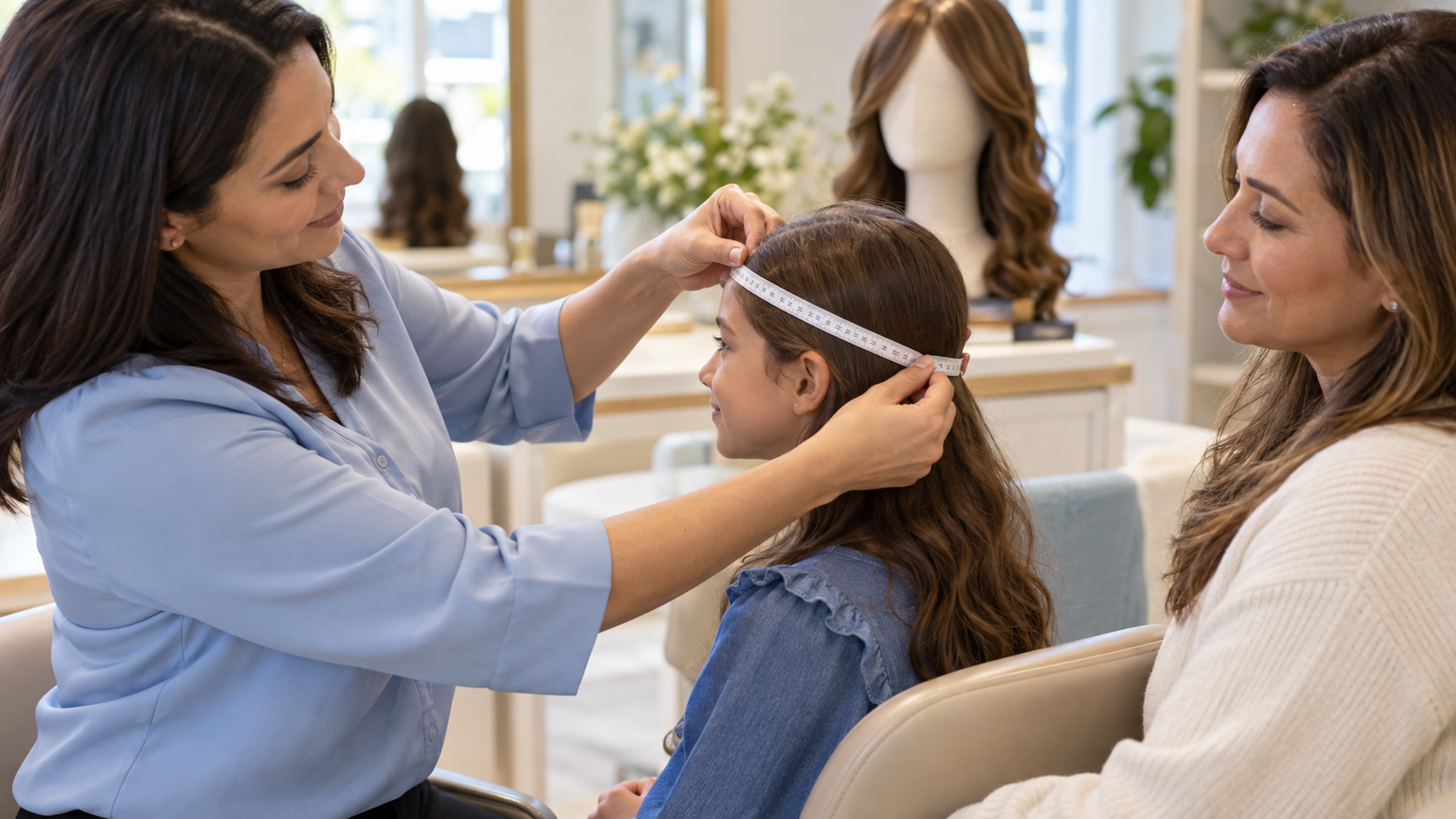
How Is a Custom Wig Made?
A custom wig is created to match the individual child rather than relying only on a standard retail size.
Although the exact process varies, it usually includes several important stages.
1. Taking Head Measurements
Accurate measurements help the wig sit in the correct position without feeling excessively tight or sliding during normal activities.
Measurements may include:
• Head circumference
• Front hairline to the nape
• Ear to ear across the forehead
• Ear to ear over the top of the head
• Temple to temple around the back
• Width of the nape
The child’s remaining hair should be flattened as much as possible during measurement. If the child is expected to lose additional hair, the wig may also need adjustable features because the fit can change as hair volume decreases. The American Cancer Society recommends selecting an adjustable wig for this reason.
2. Creating the Wig Cap
The wig cap is the foundation that sits against the scalp and holds the hair.
For a child, the cap should be:
• Appropriately sized
• Soft against sensitive skin
• Lightweight enough for regular wear
• Breathable when possible
• Secure without creating painful pressure
• Compatible with the child’s degree and pattern of hair loss
Children who have partial hair loss may need a different construction from children who have complete scalp hair loss.
3. Selecting the Hair
Wigs are generally made with human hair, synthetic fiber, or a combination of the two.
Human hair wigs often provide the most natural movement and greater styling flexibility. They can usually be cut and styled to suit the child, but they require regular care and may react to humidity much like naturally growing hair.
Synthetic wigs generally hold their original style after washing and may require less daily styling. However, ordinary synthetic fibers can be damaged by hair dryers, curling irons, ovens, open flames, and other sources of heat.
The best material depends on the child’s preferences, lifestyle, sensitivity, desired style, and the family’s ability to maintain the wig.
4. Adding and Arranging the Hair
Depending on the wig’s construction, hair may be attached to the cap by hand, machine, or a combination of both methods.
In hand-tied areas, individual strands or small groups of hair are carefully secured to the base. This can create more natural movement and allow the hair to be parted or styled in different directions.
The hairline, crown, parting area, and direction of growth all influence how natural the final wig appears.
5. Cutting and Styling
Once the hair has been attached, the wig can be cut and styled according to the child’s preferences.
Some children want a wig that closely resembles their natural hair. Others may want to try a new length, texture, color, or hairstyle.
A professional stylist with wig experience can personalize the shape around the face, adjust the bangs or hairline, remove excess bulk, and show the family how to recreate the style at home.
How to Choose the Right Wig for a Child
A beautiful wig is not necessarily the right wig. For a child, comfort and practicality matter just as much as appearance.
Begin With the Child’s Preferences
Ask the child:
• Do you want a wig?
• When would you like to wear it?
• Do you want it to resemble your natural hair?
• Would you like to try a different style or color?
• Do you prefer short or long hair?
• What would help you feel comfortable at school?
• Are you worried about the wig moving or being noticed?
Young children may respond better to photographs or several simple choices instead of a long list of questions.
Prioritize Comfort
A properly fitted wig should feel secure without causing headaches, pinching, itching, or painful pressure.
Check whether:
• The cap sits flat against the head
• The hairline is positioned naturally
• The ear areas are even
• The wig does not cover or press against the ears
• The back does not ride upward
• The child can move their head comfortably
• The base does not rub irritated or healing skin
If the scalp is sensitive because of chemotherapy, radiation, burns, surgery, or another medical condition, consult the child’s healthcare team before using adhesives or applying products directly to the skin.
Consider the Child’s Daily Routine
A wig for occasional photographs may have different requirements from one worn throughout the school day.
Consider:
• Climate and heat
• School schedule
• Sports and physical activity
• Sensory sensitivities
• The child’s ability to put it on independently
• How much daily styling is realistic
• Access to an experienced stylist
• How frequently the wig will be worn
Longer hair can offer more styling choices but usually requires more detangling and maintenance. A shorter or medium-length style may be easier for a younger child to manage.
Choose an Appropriate Color and Texture
If the child wants to match their previous hair, use clear photographs taken in natural light. A saved lock of hair can also help if hair loss is expected but has not yet occurred.
Compare colors near a window or outdoors because artificial indoor lighting can change how a shade appears. The American Cancer Society recommends using natural light when comparing a wig with a hair sample.
Texture is equally important. Straight, wavy, curly, and tightly curled hair behave differently and require different care routines.
How to Put On a Child’s Wig
Always follow the instructions provided with the specific wig. A general routine may include the following steps:
1. Make sure the child’s scalp is clean and completely dry.
2. Flatten or secure any remaining hair without pulling it tightly.
3. If recommended, place a soft wig liner or grip band on the head.
4. Hold the wig by the sides or cap—not by pulling the hair.
5. Position the front near the natural hairline.
6. Gently pull the wig over the head from front to back.
7. Align the ear tabs evenly.
8. Adjust the straps or fitting features.
9. Ask the child to turn, bend, and move their head to check comfort and security.
A wig should not be pulled too far down the forehead, placed over the ears, or tightened until it becomes uncomfortable.
A soft liner may help protect a sensitive scalp, while a cushioned wig grip can provide additional security without relying entirely on clips or adhesive.
Should Children Use Wig Tape or Adhesive?
Some wigs can be worn securely without glue or tape. Others may use skin-safe tape or adhesive, depending on the cap design and the child’s hair-loss pattern.
Before using an adhesive:
• Ask the child’s medical team if the scalp is affected by treatment, radiation, burns, wounds, or irritation
• Never apply adhesive over broken, inflamed, infected, or painful skin
• Use only products intended for wig or hair-system application
• Perform a small skin test when medically appropriate
• Follow the removal instructions carefully
• Never pull the wig off without properly releasing the adhesive
If a wig is slipping, first check the fit. Adding stronger adhesive will not correct a cap that is the wrong size.
How Often Should a Child’s Wig Be Washed?
A wig does not usually need to be washed after every use.
How often it needs cleaning depends on:
• How frequently it is worn
• Physical activity and sweating
• Weather and humidity
• Use of styling products
• Exposure to smoke, dust, or strong odors
• The wig’s material and construction
Overwashing can dry the hair, loosen knots, shorten the life of the wig, and increase tangling. Follow the care instructions provided for the specific wig rather than washing it on a fixed daily schedule.
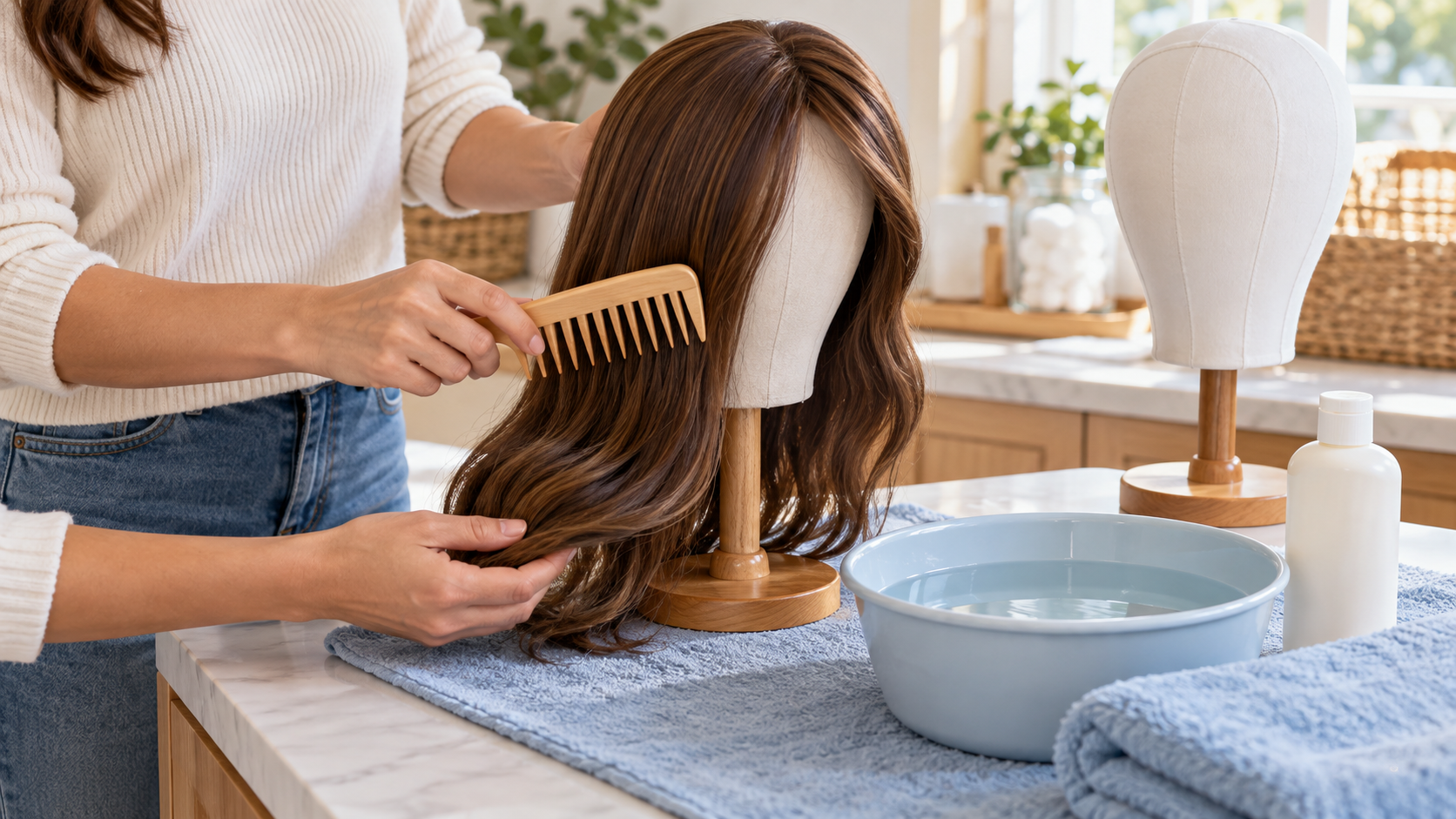
How to Wash a Human Hair Wig
Care instructions can vary, so always follow the guidance provided by the wig maker. A general routine for a human hair wig is:
Step 1: Detangle Before Washing
Place the wig on a stand or hold it securely at the cap.
Using a wide-tooth comb or wig brush, gently detangle the hair. Begin at the ends and slowly work upward. Do not pull forcefully through knots.
Step 2: Use Cool or Lukewarm Water
Avoid very hot water, which may affect the hair, base, knots, or shape of the wig.
Keep the hair moving in the same direction to reduce tangling.
Step 3: Apply Wig-Safe Shampoo
Use a small amount of shampoo recommended for human hair wigs.
Gently distribute it through the hair. Do not scrub, twist, bunch, or rub the strands together.
Step 4: Rinse Thoroughly
Rinse in the direction of the hair until the water runs clear. Avoid directing strong water pressure at delicate lace or hand-tied areas.
Step 5: Condition Carefully
Apply conditioner primarily through the mid-lengths and ends. Avoid placing heavy conditioner directly on the cap or knots unless the wig maker specifically recommends it, as this may loosen the hair attachment.
Rinse thoroughly.
Step 6: Remove Excess Water
Gently blot the wig with a soft towel. Do not wring or twist it.
Step 7: Air-Dry
Place the wig on an appropriate stand and allow it to dry naturally in a well-ventilated area away from direct sunlight.
Do not brush aggressively while it is wet. Use heat only if the wig maker confirms that the wig can tolerate it, and select the lowest effective temperature.
Daily Wig-Care Tips
To help a child’s wig remain comfortable and natural-looking:
• Detangle gently, starting at the ends
• Use only products suitable for the wig material
• Avoid excessive hairspray, oil, or heavy styling products
• Do not sleep or shower in the wig unless specifically instructed
• Remove the wig carefully using the recommended method
• Keep the inside of the cap clean
• Check regularly for worn areas, loose hair, torn lace, or damaged fasteners
• Keep the wig away from pets and young siblings
• Schedule professional maintenance when needed
If the child’s scalp becomes red, painful, itchy, swollen, or irritated, stop using the wig and speak with the child’s healthcare team.
How to Store a Wig
When the wig is not being worn:
• Place it on a suitable wig stand
• Keep it away from direct sunlight
• Avoid heaters, stoves, and humid bathrooms
• Make sure it is completely dry before storing
• Protect it from dust
• Do not crush it beneath clothing or other objects
For travel, use a wig box or carefully turn the wig inside out and place it in a clean protective bag, following the wig provider’s instructions.
Proper storage helps preserve the cap shape, hair direction, and finished style.
Help the Child Build Confidence With the Wig
A child may need time to become comfortable wearing a wig.
Begin with short practice periods at home. Let the child look in the mirror, move around, wear glasses or accessories, and practice taking the wig on and off.
Before returning to school, families may also:
• Decide how the child wants to answer questions
• Speak privately with a teacher or counselor
• Identify a safe place where the child can adjust the wig
• Pack a comb, small mirror, or backup head covering
• Discuss what to do if another child touches or pulls the wig
• Make sure the child knows which trusted adult can help
Avoid promising that no one will notice the wig. Instead, help the child prepare for different situations and remind them that they control how much they want to share.
How Little Heroes Hair Helps
Little Heroes Hair provides free, custom-made human hair wigs to eligible children under age 18 experiencing hair loss due to illness, medical treatment, alopecia, burns, congenital conditions, and other causes.
Each wig is created using the child’s measurements and preferences, including hair color, length, texture, and style. The typical production time is approximately six to eight weeks after all required information has been received.
Our goal is not to tell children that they need hair to feel confident. Our goal is to give each child another choice—one that may help them feel comfortable, express their personality, and participate more freely in everyday life.
Learn more about Little Heroes Hair or apply for a free custom wig.
The Right Wig Should Feel Like the Child’s Own Choice
Choosing a child’s wig involves more than selecting a color or hairstyle. Fit, comfort, scalp health, daily activities, maintenance, and the child’s personal preferences all matter.
A well-made wig should support the child’s life—not control it.
Listen to the child, follow medical guidance when the scalp is sensitive, learn the correct care routine, and allow time for adjustment. Whether the child wears a wig every day, only occasionally, or not at all, their comfort and voice should remain at the center of every decision.
A Wig, A Smile, A Happier Child.
This article provides general educational information. Families should consult the child’s healthcare team regarding scalp care, adhesives, skin irritation, wounds, radiation-treated skin, or other medical concerns.
Sources
• American Cancer Society: Wigs for Hair Loss
• National Cancer Institute: Support for Families During Childhood Cancer
• Together by St. Jude: Hair Loss in Childhood Cancer
• Little Heroes Hair: Frequently Asked Questions
• Little Heroes Hair: Free Wigs for Kids
Comments
No comments yet.