

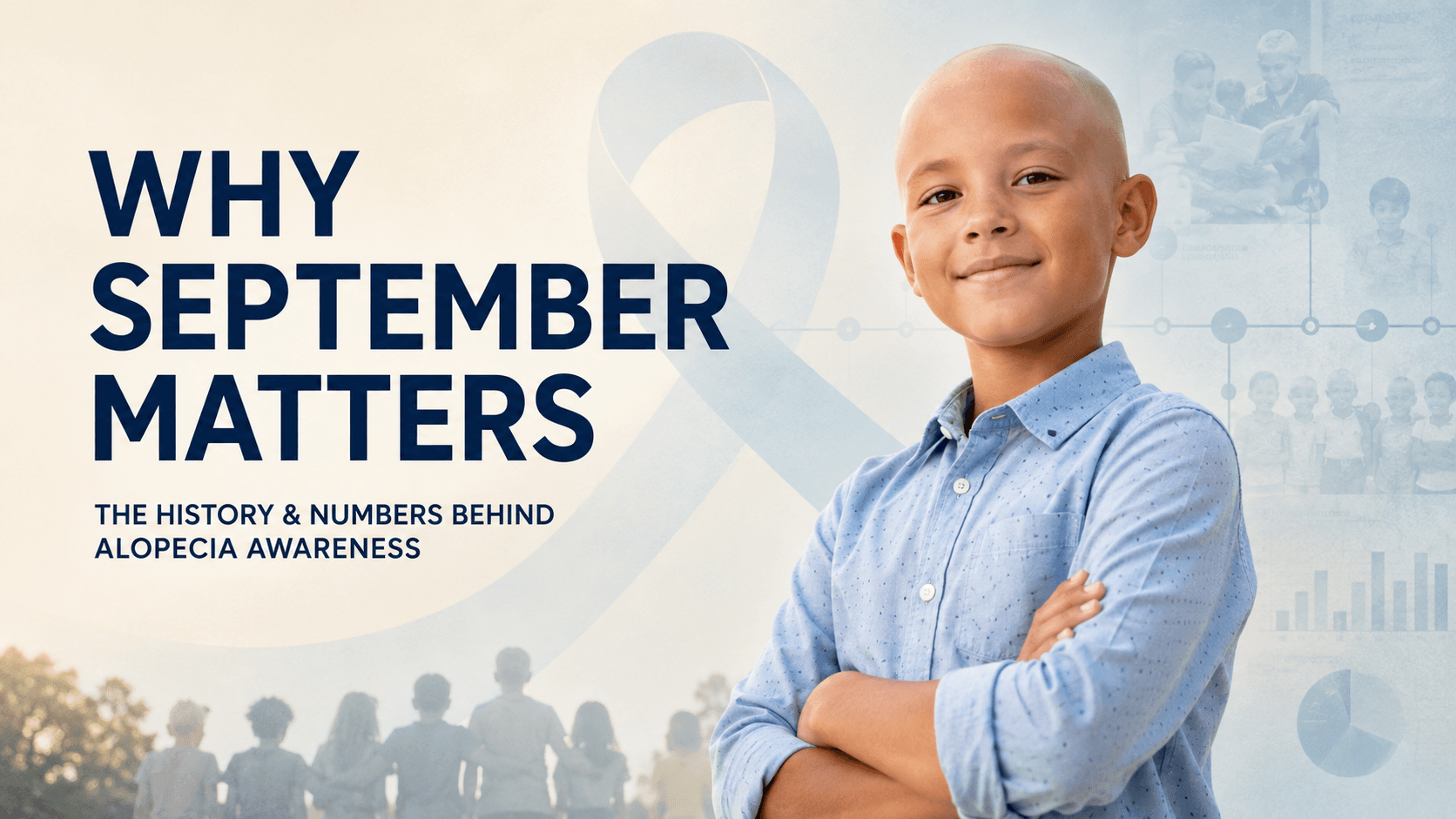
Why September Matters: The History and Numbers Behind Alopecia Areata Awareness Month
- Written by Little heroes hair
- |
- Aug 25, 2026
- |
- 4 min read
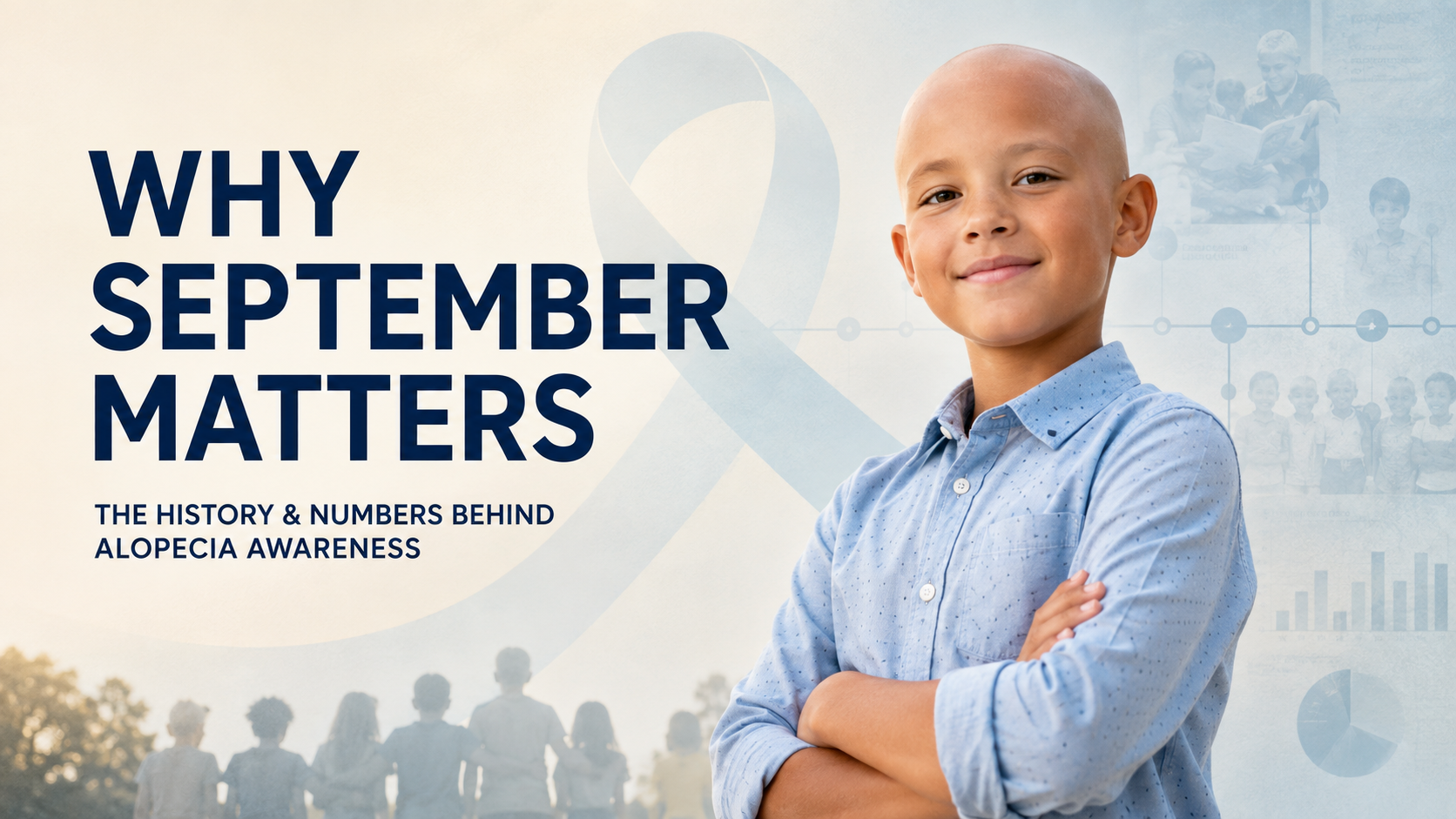
Every September, individuals, families, healthcare professionals, schools, and nonprofit organizations come together for Alopecia Areata Awareness Month.
For people living with alopecia areata, this month is more than an awareness campaign. It is an opportunity to replace myths with facts, reduce the stigma surrounding hair loss, increase access to support, and remind children and adults affected by the condition that they are not alone.
But how did Alopecia Areata Awareness Month begin, and how many people does this condition affect?
The Origins of Alopecia Areata Awareness Month
The modern alopecia awareness movement in the United States developed alongside the growth of organized patient support and advocacy.
The National Alopecia Areata Foundation (NAAF) was established in 1981 to support people affected by alopecia areata, encourage scientific research, and educate the public. Today, NAAF is considered one of the world’s largest organizations representing the alopecia areata community.
National recognition followed. In 1985, the United States Congress designated a National Alopecia Areata Awareness Week. By 2002, the Congressional Record was formally recognizing September as Alopecia Areata Awareness Month.
What began as a shorter period of national recognition has grown into a month-long campaign. Each September, the alopecia community shares personal stories, organizes educational programs and events, supports research, and works to reduce the misunderstanding often associated with visible hair loss.
Today, NAAF describes the month as a time to:
- Increase public understanding
- Reduce stigma and misinformation
- Empower people living with alopecia areata
- Connect affected individuals and families
- Encourage advocacy, support, and research
In 2026, the awareness campaign will include the national Walk for Alopecia on September 26, with flagship events, community walks, and “Walk Where You Are” participation.

What Is Alopecia Areata?
Alopecia areata is a chronic autoimmune disease.
It occurs when the immune system mistakenly attacks healthy hair follicles, resulting in hair loss. The condition often begins with round or oval patches on the scalp, but it can also affect eyebrows, eyelashes, facial hair, and other parts of the body.
The name itself describes the condition:
- Alopecia means hair loss.
- Areata means occurring in patches or defined areas.
Alopecia areata can appear in several different forms.
Alopecia areata most commonly causes round or oval patches of hair loss on the scalp, although other areas of the body may also be affected.
Alopecia totalis refers to the complete loss of hair on the scalp.
Alopecia universalis is a less common and more extensive form that causes hair loss across the scalp and the rest of the body.
Ophiasis alopecia causes hair loss in a band-like pattern, usually around the sides and back of the scalp.
The type and extent of hair loss can vary from person to person and may also change over time.
Hair loss forming a band around the sides or back of the scalp
Alopecia areata is not contagious, and it is not caused by poor hygiene. It can affect people of every race, gender, and age.
Alopecia Areata by the Numbers
Different studies measure alopecia areata in different ways. Some calculate how many people currently have the condition, while others estimate the likelihood of developing it at some point during a lifetime.
Here are several important statistics:
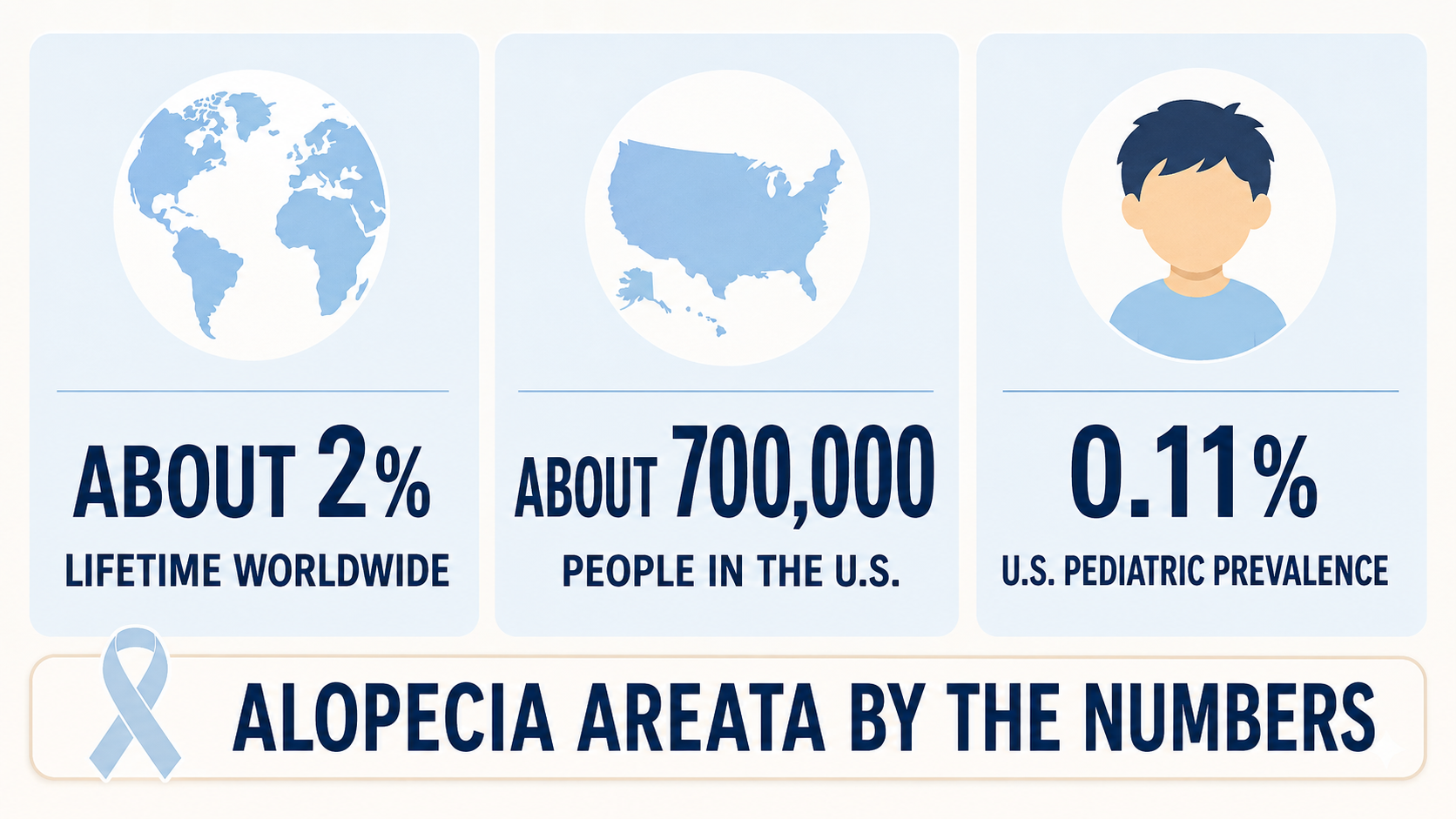
About 2% of people may experience it during their lifetime
The National Alopecia Areata Foundation estimates that approximately 2% of people worldwide will experience alopecia areata at some point in their lives.
This means alopecia areata is not as rare as many people assume.
Approximately 700,000 people in the United States may currently have it
A large U.S. survey estimated the current prevalence of alopecia areata at approximately 0.21%, representing around 700,000 people at the time of the study.
The same research estimated that approximately 300,000 people were living with moderate-to-severe alopecia areata.
Alopecia areata frequently begins at a young age
According to the American Academy of Dermatology, alopecia areata commonly begins during childhood or young adulthood, although it can develop at any age.
A large U.S. pediatric study covering 2009 through 2020 found:
- An overall pediatric prevalence of approximately 0.11%
- An incidence rate of 13.6 new cases per 100,000 children per year
- The incidence in the study population peaked around age six
- The condition affected children from every racial and ethnic group
These figures show why children, parents, schools, and pediatric healthcare providers are an important part of alopecia awareness efforts.
The Numbers Do Not Show the Entire Impact
Statistics help us understand the size of the alopecia community, but they cannot fully describe the experience of losing hair—especially during childhood.
A child with alopecia may face questions, staring, teasing, or bullying. They may feel anxious about attending school, taking photographs, joining sports, swimming, or meeting new people.
Because the child may otherwise appear physically healthy, adults do not always recognize the emotional effects of the condition.
For some children, hair loss may influence:
- Confidence and self-image
- School attendance and participation
- Friendships and social activities
- Anxiety about being photographed
- Willingness to participate in sports or swimming
- Feelings of privacy and personal control
This is one reason awareness matters. When classmates, teachers, relatives, and community members understand alopecia areata, children are less likely to be defined by their appearance.
Why September Awareness Still Matters
Greater public visibility has helped more people recognize alopecia areata, but misunderstandings remain.
Some people incorrectly assume that every person without hair has cancer. Others believe alopecia is contagious or caused by stress alone. Children may also be asked intrusive questions or touched without permission.
Awareness Month gives communities an opportunity to correct these assumptions and promote more respectful behavior.
Meaningful awareness means understanding that:
- Alopecia areata is an autoimmune disease.
- It is not contagious.
- A child did not cause their hair loss.
- Hair loss may be temporary, recurring, or long-term.
- Every person experiences alopecia differently.
- Not everyone wants to cover their hair loss.
- Choosing a wig, hat, scarf, or no covering at all is a personal decision.
Awareness should not pressure children to look a particular way. Instead, it should give them information, support, and the freedom to make their own choices.
How Little Heroes Hair Supports Children With Alopecia
Little Heroes Hair provides free, custom-made human hair wigs to eligible children under the age of 18 experiencing alopecia and other forms of medical hair loss.
Each child’s wig is customized according to their measurements and preferences, including hair color, length, texture, and hairstyle.
For some children, wearing a wig can make it easier to return to school, participate in activities, take family photographs, or simply feel more like themselves. For others, a wig may be something they wear only occasionally.
A wig is not a requirement for confidence or beauty. It is a choice—and providing that choice can help return a sense of control to a child experiencing unpredictable hair loss.
There is no cost to eligible families.
Learn more about Little Heroes Hair and our free wig program.
How You Can Participate This September
You do not need to organize a large event to make a difference. During Alopecia Areata Awareness Month, you can:
- Share accurate information from trusted organizations
- Correct myths about alopecia
- Speak up against hair-loss-related bullying
- Ask schools to provide a supportive environment
- Respect each person’s choice about wigs and head coverings
- Share personal stories only with permission
- Donate hair or financial support
- Volunteer with organizations serving children with hair loss
- Participate in a local or virtual awareness event
- Even one informed and compassionate conversation can help a child feel safer and more accepted.
Awareness Begins With Seeing the Whole Child
Alopecia areata can change a child’s hair, but it does not change their personality, abilities, creativity, dreams, or worth.
The history of Alopecia Areata Awareness Month shows what can happen when patients, families, researchers, advocates, and communities work together. The statistics show that hundreds of thousands of people are affected. The stories behind those numbers remind us why continued awareness is necessary.
This September, let us see the whole child—not only the hair they have lost.
A Wig, A Smile, A Happier Child.
Sources
National Alopecia Areata Foundation: Awareness Month
National Alopecia Areata Foundation: About NAAF
NAAF: Understanding Alopecia Areata
American Academy of Dermatology: Alopecia Areata Overview
U.S. Pediatric Alopecia Areata Study
U.S. Alopecia Areata Prevalence Study
1985 Congressional Awareness Week Record
2002 Congressional Recognition of Awareness Month
Comments
No comments yet.